

This post contains affiliate links. If you sign up through them, I may earn a small commission at no extra cost to you.
To streamline your business systems with ClickUp, start by putting one workflow in one place: tasks with clear owners and due dates, conversations kept on the tasks they’re about, and views that show each person what they need. Then add dashboards for visibility, forms to bring work in, integrations to connect your other tools, and automations to take repetitive steps off your plate. Build one system at a time, around how your business actually runs.
Updated November 2026
If your business runs on a mix of tools, tabs, and things you’re holding in your head, you’re not alone, and you’re not the problem. Most service business and small agency owners I talk to don’t lack drive or discipline. What they lack is one system that fits the way they and their team actually work.
When it’s set up with intention, ClickUp can be that system. This guide covers the features that make the biggest difference, how to use them, and the habits that keep your workspace running smoothly.
What does it mean to streamline your business systems?
It means your work has one home, everyone knows what they’re responsible for, and repeatable work happens the same way every time, without you having to remember it.
A well-designed system helps you:
- Make fewer decisions about where things go and what’s next
- Cut out repetitive manual steps
- Deliver to clients more consistently
- Catch deadlines before they slip
- Grow without adding more chaos
If you’re spending more time managing your work than doing it, that’s usually the sign your systems haven’t kept up with your business.
Why use ClickUp to run your business?
ClickUp works best as more than a project management tool. It can hold the whole operation:
- Projects and client work
- Documentation, SOPs, and knowledge
- Team conversations
- Time tracking
- Automations
- Client and lead management
- Dashboards and reporting
What matters most is how you set it up. Here’s how I’d approach each piece.
Start with tasks, owners, and due dates
Every system starts here. Organize work into clear lists, give every task one owner, and set due dates. Use subtasks and checklists for the steps inside a bigger piece of work.
This one habit does a lot. When every task has an owner and a date, “who’s doing this?” and “when is it due?” stop being questions.
Keep conversations on the work
Instead of chasing updates through Slack, email, texts, or DMs, keep the discussion on the task it’s about. Comments, files, and updates stay attached to the work, so anyone can catch up without asking.
ClickUp also has Chat built in now, with channels and direct messages. You can turn a message into a task or connect it to existing work. I cover Chat and other newer features in New ClickUp Features Worth Using.
Choose views that fit how each person works
Everyone processes information differently. Views let each person see the same work in the way that makes sense to them.
- Board view: great for visual thinkers. Drag tasks across stages and spot bottlenecks quickly.
- List view: clean and structured, good for detail-oriented work.
- Calendar view: see content, deadlines, and deliverables at a glance. You can also sync with Google Calendar or Outlook.
- Gantt or Timeline view: helpful for project planning and seeing how work overlaps.
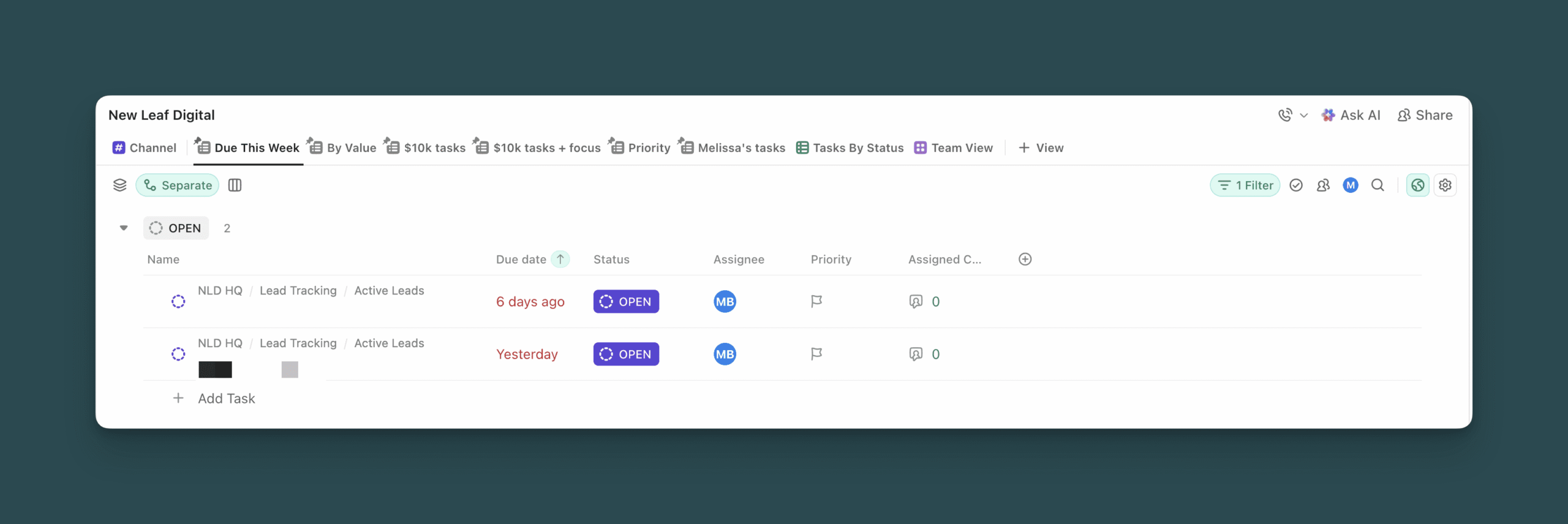
Saved views are where views really pay off. Create filtered views like “Due This Week,” “Ready for Review,” or “Client Delivery Only,” so your team only sees what they need right now.
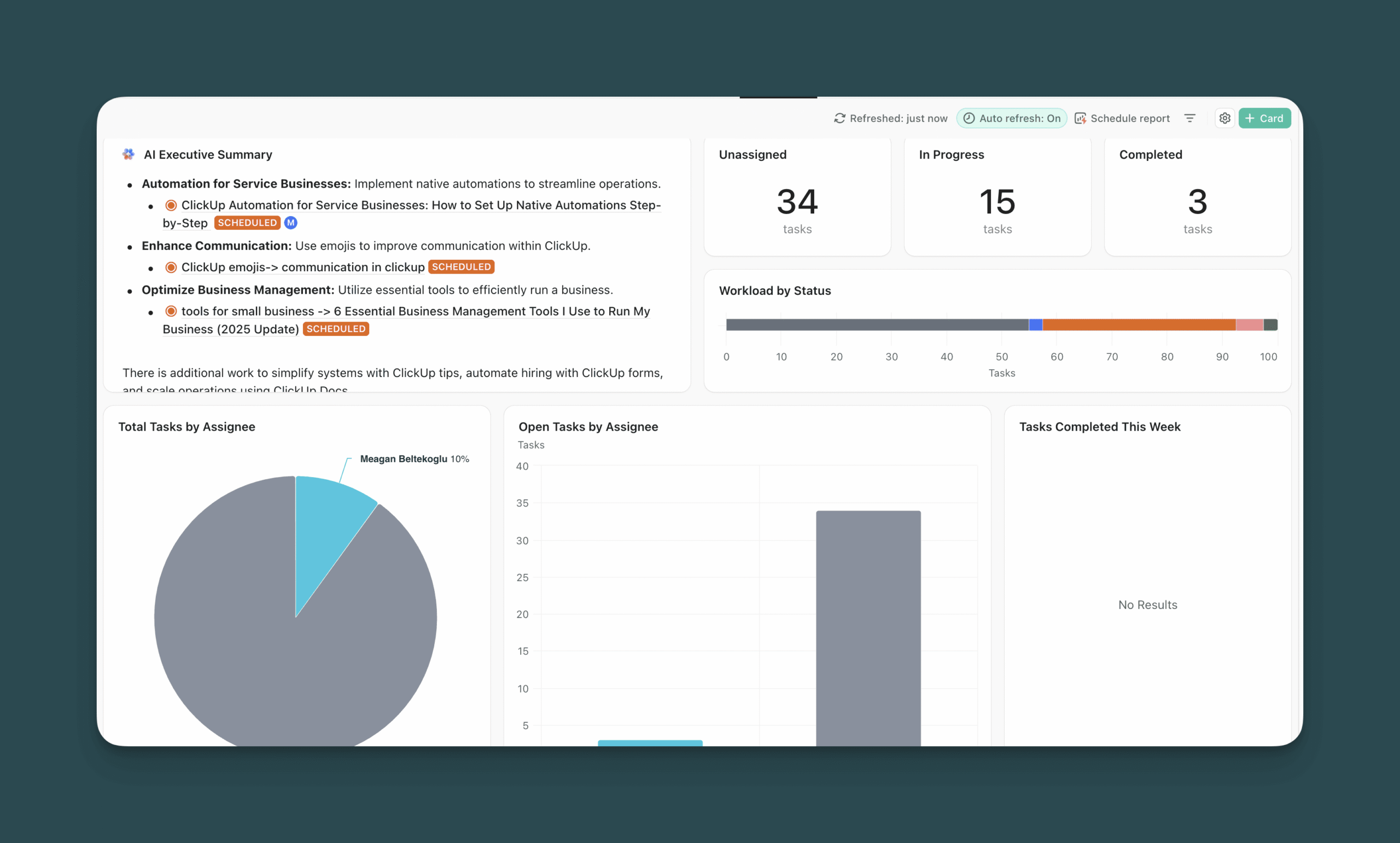
See what’s happening with dashboards
Dashboards pull your key information into one place, so you don’t have to click through lists to find out where things stand. Use them to see:
- Project progress
- Client delivery status
- Team workload and activity
- Important links and resources
Start with the questions you ask most often, like “what’s overdue?” or “who has room for more work?”, and build cards that answer them. I walk through this in how to use ClickUp dashboards to make data-based decisions.
Bring work in with forms
ClickUp forms create tasks automatically, so requests land in the right list with the right details instead of in your inbox. Use them for lead capture, client onboarding, asset collection, and support requests. Here’s how to add automations to ClickUp forms.
Connect the tools you already use
ClickUp works best as your home base, with your other tools connected to it. Some of the most useful connections:
- Slack: turn messages into tasks and get updates where you already are
- Google Drive: attach files without digging, and create folders automatically when tasks are created
- Gmail: turn emails into tasks
- Calendly: log appointments in ClickUp
- Zoom, Stripe, and more: connect what your business runs on
When a native integration doesn’t do what you need, Make or Zapier can connect almost anything.
Take repetitive work off your plate with automations
Automations handle the steps that happen the same way every time. For example:
- Assign tasks when they’re created
- Change statuses or move tasks to another list
- Update due dates
- Create recurring tasks
- Send reminders, emails, or messages
You can add conditions too: when the status changes to “Ready for Review” and the assignee is the designer, reassign it to the project manager. Small steps like these add up to hours each month. Here’s how to set up a native automation in ClickUp.
ClickUp’s AI features can take on work that needs a little more judgment. If you’re deciding between an automation and AI, I break that down in Automations, AI Fields, Super Agents, or Claude?
Track time to understand capacity and pricing
Time tracking shows you how long work actually takes, which helps you:
- Price your services more accurately
- See who has capacity before you assign more work
- Make better hiring decisions
- Spot where time is quietly going
- Stop underestimating your own workload
Pair tracked time with time estimates and timesheets, and you’ll have a much clearer picture of how your business runs and whether each client is actually profitable.
What this looks like in a real business
When these pieces come together, the results show up in hours, not just tidier lists.
- A custom embroidery seller I worked with was managing every order by hand. After we streamlined her order process in ClickUp, she saves 10+ hours a week. Read her story.
- A college essay consulting firm saves 10+ hours a month with ClickUp automation, and beat its previous year’s income by October. Read the case study.
Best practices for using ClickUp effectively
Start with your business, not the software
Get clear on how work moves through your business and where it gets stuck before you build anything. Business first, process second, technology third.
Start small with one system
Pick one workflow, like client onboarding or content, and know what you want it to help you do. Get that working before you move on to the next one.
Customize ClickUp to fit your business
Your statuses, views, Spaces, and fields should support your workflows, not complicate them.
Keep your structure simple
If your ClickUp is messy, your business will feel messy. Fewer, clearer lists and fields are easier for everyone to follow.
Document your processes
Store SOPs, workflows, scripts, and templates in ClickUp Docs so your system doesn’t depend on any one person remembering how things work.
Maintain it weekly
A 10-minute weekly reset (closing old tasks, updating due dates, and tidying lists) saves hours of confusion later.
Frequently asked questions
Is ClickUp hard to learn?
Not when your workspace is built intentionally. ClickUp can do a lot, which can feel overwhelming, but a clean setup with only what your team needs is simple to follow.
What should I set up first in ClickUp?
Start with the workflow that causes you the most stress, often client delivery or onboarding. Set up a list, clear statuses, and owners and due dates for every task. Add views, dashboards, and automations once that’s working.
How long does it take to move a business into ClickUp?
I recommend moving one system at a time so your team can adjust. Most businesses can fully transition one system in a few weeks, depending on size and complexity.
Can ClickUp replace my other tools?
Often, yes. Many businesses use ClickUp in place of separate tools for project management, docs, time tracking, and team chat, like Trello, Asana, Google Docs, Toggl, or Notion. Which tools it replaces depends on how your business works.
Does ClickUp help with team accountability?
Yes. Clear owners, due dates, comments, and dashboards make it easy to see who’s responsible for what and where things stand, without constant check-ins.
Will ClickUp work for solopreneurs?
Yes, especially if you want to get details out of your head and build systems that are ready when you hire help.
Want a ClickUp system built around your business?
If you want a system built around the way you think and the way your business operates, I’d love to help.
I’m Meagan B., a ClickUp expert, Verified ClickUp Consultant, and Certified Director of Operations. I help women-led service businesses and small agencies turn ClickUp into a simple system their team can run. You can see client results in my case studies or learn more about my services.
Book a free call → (it’s free, promise)